Can AI help a vibe coder beat a senior developer? Let's find out 👀
Featuring: @ankushdharkar, @ohshinbhat, and @the_natt 💚

HackerRank ran this as an experiment. Three people got one brief: build an AI agent that reads HackerRank's support tickets and decides whether to reply or escalate it to a human. Same repo for all three with the tickets and the help centre in it, half an hour to plan, then a two-hour build clock, and three lifeline cards on the table: phone a real engineer at a cost of fifteen minutes, fifteen minutes of borrowed time, one Diet Coke. What separates them is the badge and the stack. Sudarshan N Srinivas wore the vibe coder badge and worked in Cursor with Opus 4.8, Ohshin Bhat wore the junior developer badge and used Codex with GPT 5.5, and Ankush Dharkar wore the senior developer badge and used Claude Code with Opus 4.8. At the end an AI judge reads every line of code, every prompt and every answer the three of them produced, and picks one. HackerRank's whole business is measuring what a developer can do, and the film signs off on the line "Hire for the agentic era", so this is a company putting the question to itself: what is left to measure once the agent does the writing. That is live for founders here on both sides of it, the ones hiring engineers and the ones shipping this way themselves.
 HackerRank
Can AI help a vibe coder beat a senior developer? Let's find out 👀
Featuring: @ankushdharkar, @ohshinbhat, and @the_natt 💚
 Jash Gor
 3w
3w
🚁 *Introducing Vayu Veer UAV Systems by RCSL — Engineered for Critical Missions.*
Proud to share *Vayu Veer*, a versatile UAV family developed to support diverse real-world operational requirements.
One UAV family. Multiple mission capabilities:
🔹 *RX4* — Surveillance & Thermal Intelligence
🔹 *RX7* — High-Speed FPV & Precision Payload Delivery
🔹 *RX8* — Heavy-Lift Firefighting, Rescue & Logistics
🔹 *RX9* — 30 kg Heavy-Payload Operations
From infrastructure inspection and night surveillance to firefighting, emergency response, rescue operations, and critical logistics, *Vayu Veer is designed to take capability where it matters most.*
What stands out is its *mission-ready and modular approach*, built around practical operational needs.
🇮🇳 *Vayu Veer UAV System by RCSL*
Designed for critical missions. Built for impact.
Image from Stir Advisors
From Stir Advisors
The best exits don't start when the banker enters the room. They start twelve to eighteen months earlier, in the quiet work of tightening margins, cleaning cap tables, and rehearsing the narrative until it's the one buyers repeat back to you.
By the time due diligence begins, the outcome is largely priced in. What looks like negotiation is often just discovery, the buyer verifying what your positioning already told them.
At Stir Advisors we treat sell-side mandates as an operating programme, not a brochure process. [...]
Image from Stir Advisors
From Stir Advisors
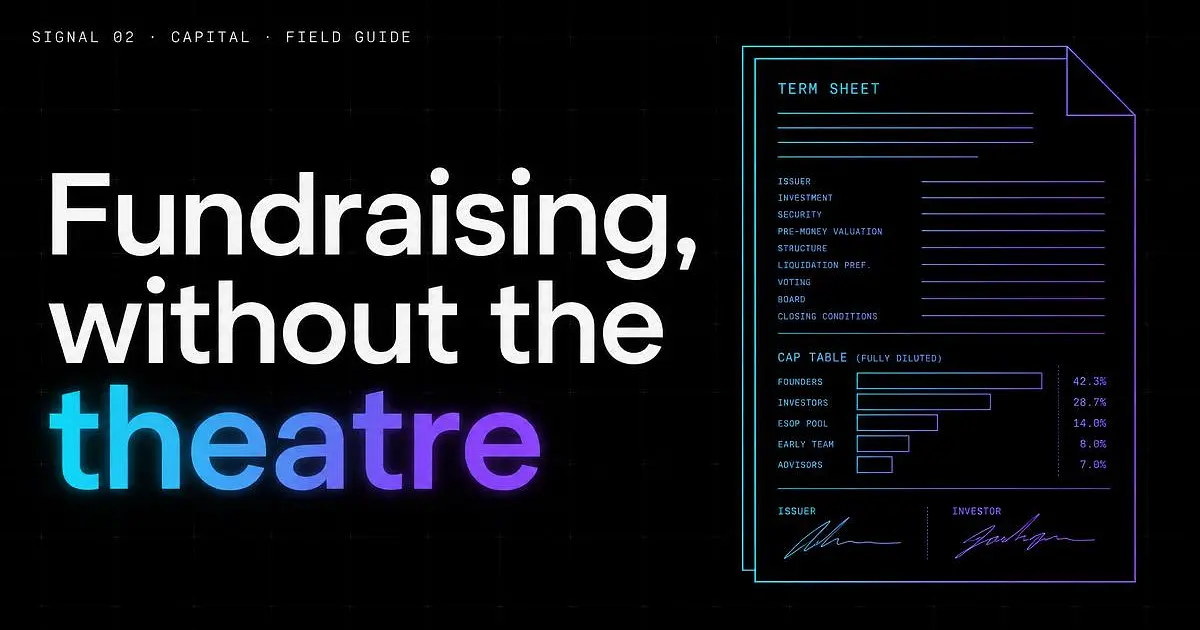
Most rounds are lost in the meeting before the meeting, the informal partner call that decides whether your deal even reaches the Monday partnership.
Term sheets are downstream artifacts. If the narrative, comps, and champion are wired correctly, terms tend to normalise. If they aren't, no clever mechanic recovers the round.
Whether equity, debt, or structured capital, dilution and cost of capital are the last things to negotiate, not the first things to fear. Clarity of use of proceeds and path to liquidity always outrank valuation theatre.