-
 Utpal Vaishnav

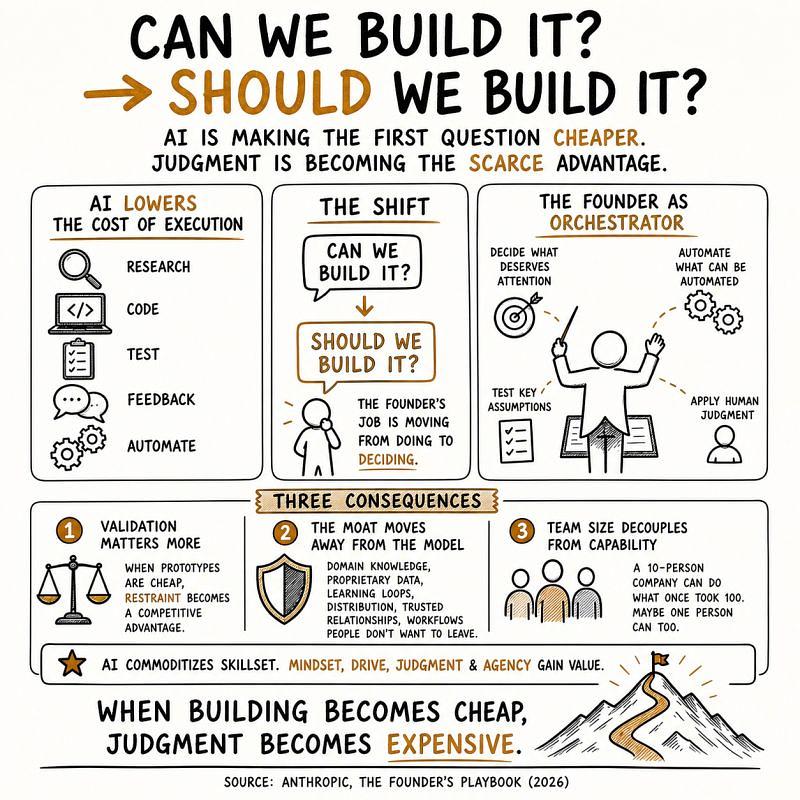
"Can we build it?" is becoming the wrong startup question.
Anthropic recently published The Founder's Playbook, mapping the AI-native startup journey across four stages:
- Idea.
- MVP.
- Launch.
- Scale.I went through it.
What stayed with me wasn't Claude, agents, or even the possibility of billion-dollar one-person companies.
It was a simpler shift.
For decades, one of the hardest questions in entrepreneurship was:
Can we build it?AI is rapidly making that question cheaper to answer.
A founder can research a market, prototype an interface, write code, test positioning, analyze feedback, and automate operations with capabilities that once required a team.
That creates a strange new problem.
We can now build the wrong thing much faster.
So the scarce capability is shifting.
From execution to judgment.
From:
Can we build it?To:
Should we build it?That changes the founder's job too.
The founder increasingly becomes an orchestrator.
Not someone removed from the work. Someone operating one level above it.
Deciding what deserves attention.
- What should be automated.
- What requires human judgment.
- Which assumptions need testing.And what should never be built in the first place.
Three other shifts in the playbook are worth sitting with.
First, validation becomes more important as building becomes cheaper.
When prototypes are expensive, teams naturally build carefully. When prototypes become almost free, restraint becomes a competitive advantage.
Second, the moat moves away from the model.
Everyone can access powerful intelligence. Far fewer companies possess deep domain knowledge, proprietary learning loops, behavioral data, trusted relationships, or workflows customers don't want to leave.
Third, team size begins to decouple from capability.
A 10-person company can increasingly carry capabilities that once required 100 people. Perhaps, eventually, one person can too.
This connects strongly with something I have been exploring through MSDx.
As AI commoditizes parts of Skillset, the relative value of Mindset, Drive, judgment, and agency increases.
- The machine can produce more moves.
- The founder still has to decide which game is worth playing.That may be the real startup shift of 2026.
AI doesn't merely let more people build.
Building is becoming so abundant that choosing what deserves to exist becomes the advantage.
#DhandheKaFunda: When building becomes cheap, judgment becomes expensive.
Utpal Vaishnav on eChai Founder Notes
eChai Partner Brands
The partnership →