GPT6-Astra is world class at building games. It just created a SKYRIM inspired game with just 1 prompt!
Using @TesanaAI Game maker together with Open AI's latest model I got this openworld AAA game. Full with quests, cities and a big dragon boss.

What is being built with AI, how it is put to work, and what happens when it goes wrong.
 Kavin Karthik
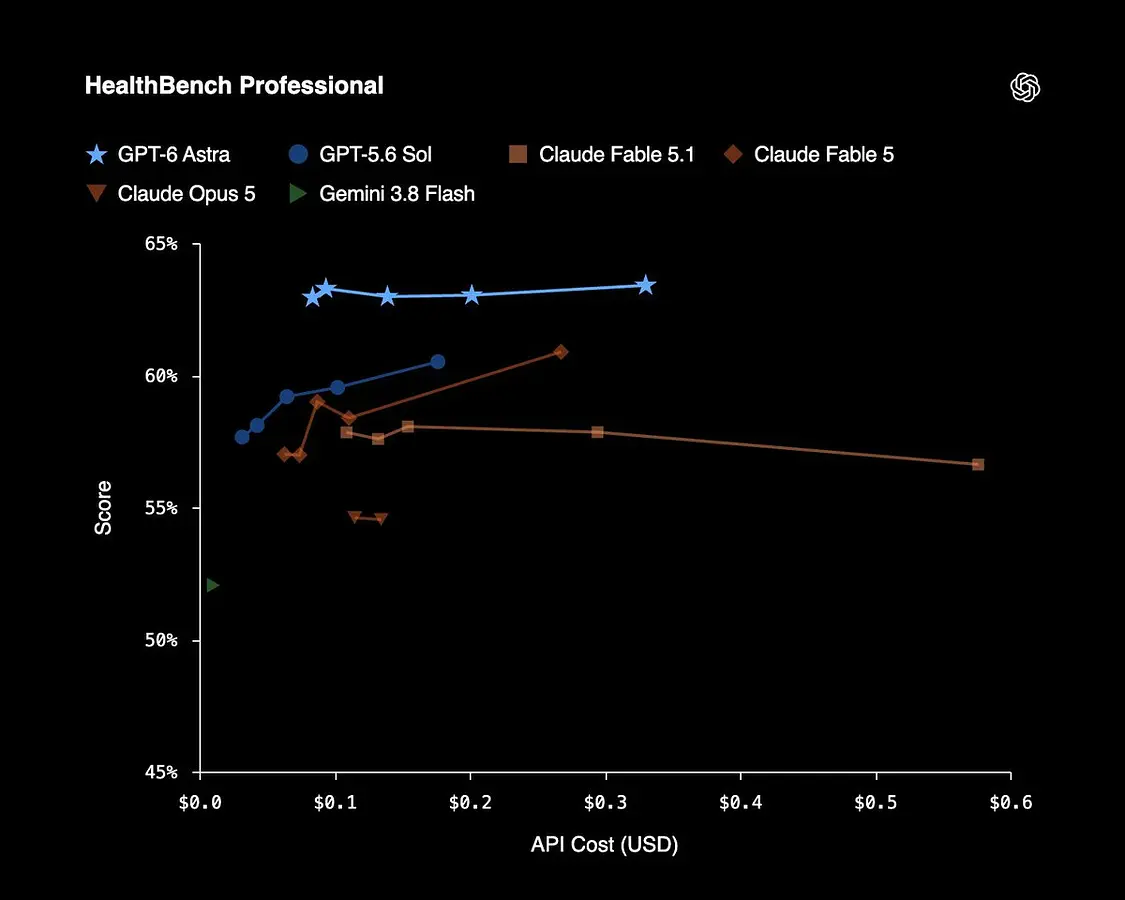
GPT-6 Astra is now out and this was my team's daily driver in the last few months as we built the Healthcare products.
An absolute beast on Coding and Healthcare. This is one of first models where I could hand over long duration tasks using Computer Use and expect it to get things done!
Aaron Levie is at Box, and the test he is describing is Box's own internal eval rather than a public benchmark.
 Aaron Levie
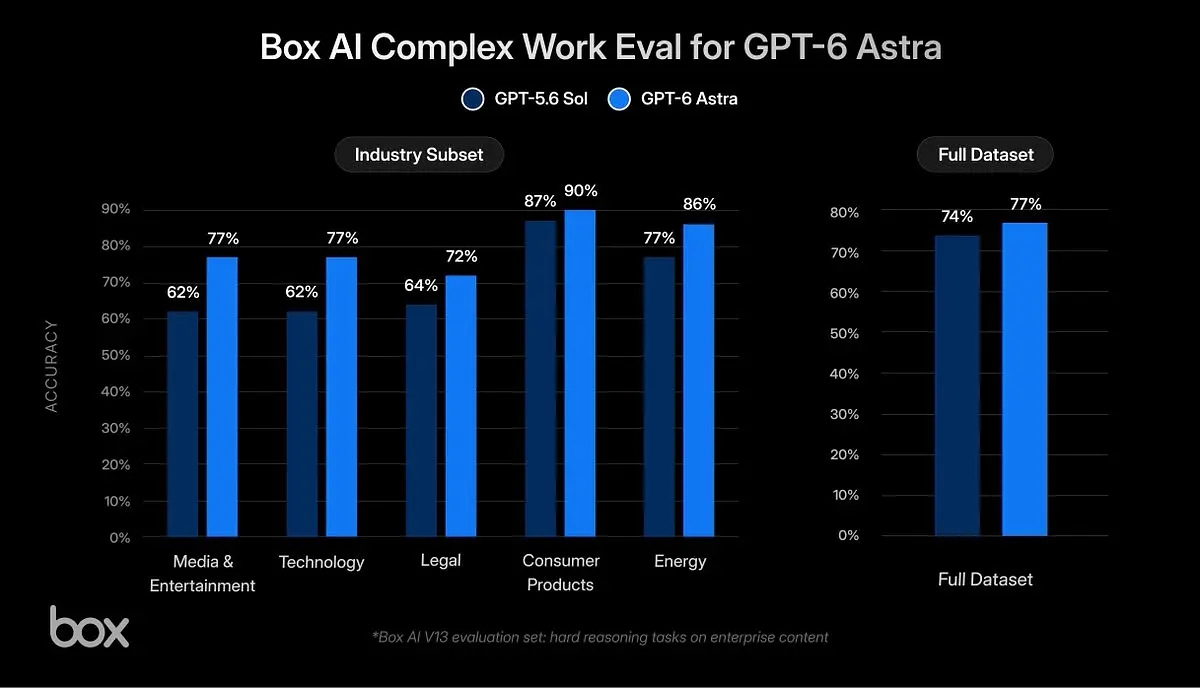
GPT-6 Astra is out. We've been testing the model in early preview on our enterprise complex work eval at Box. It is now the best model we've ever tested on our expanded and hardest test set.
The claim is cost per TASK rather than cost per token, which is the figure that decides whether something is affordable to run.
 cheaty
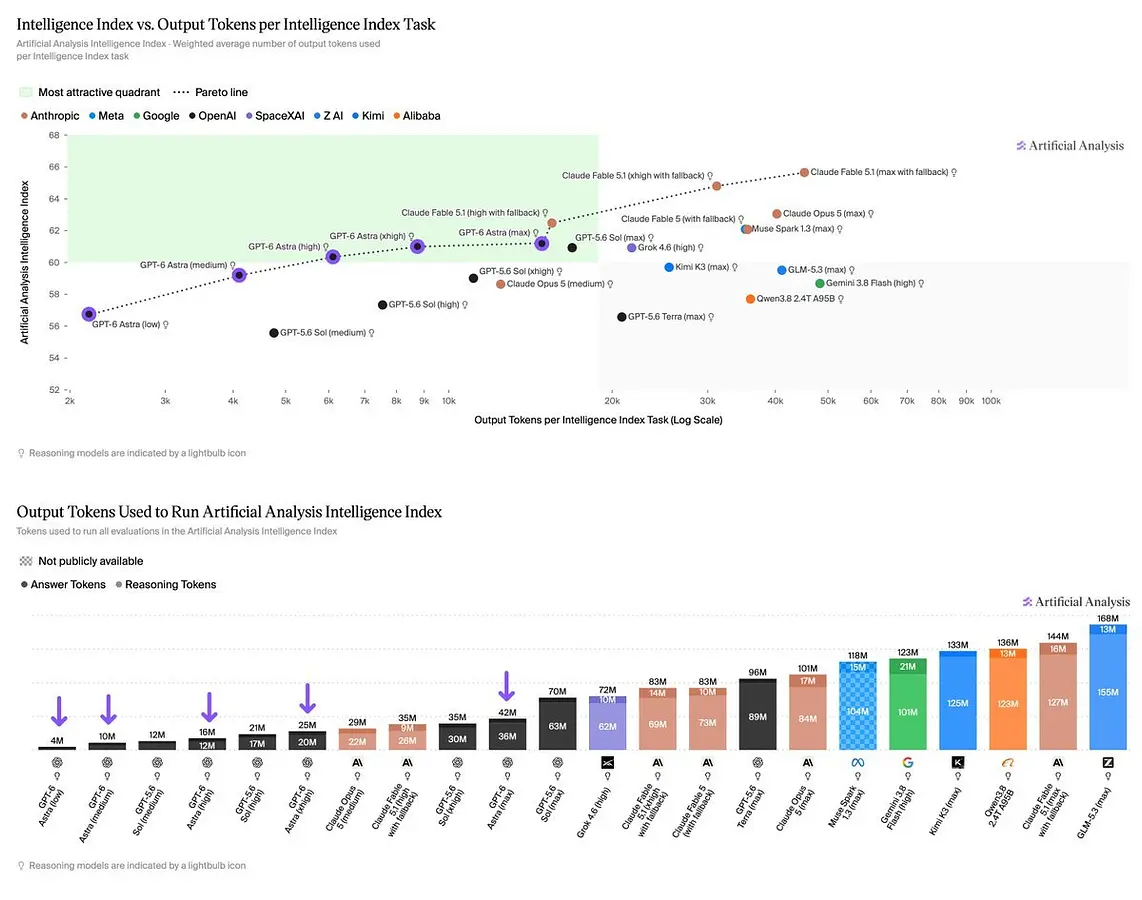
GPT-6 Astra is on the pareto-frontier of cost efficiency due to being EXTREMELY token efficient. It is in a whole league of it's own.
It is cheaper than Gemini 3.8 Flash per task (a model 13x cheaper than Astra).
Max Weinbach, of Creative Strategies. The thing he describes is live at the link, so this is one of the few Astra demos you can open and use rather than watch.
 Max Weinbach
Another fun demo of Astra, I realized like 3.5 hours ago I didn't have a cool enough demo
In 75 minutes, I gave it the same simulate macOS 27 prompt. It's BY FAR the best output I've seen. If you log in, it also has cloud sync and working apps
Wade Foster is at Zapier, and AutomationBench is their own benchmark rather than a public one.
 Wade Foster
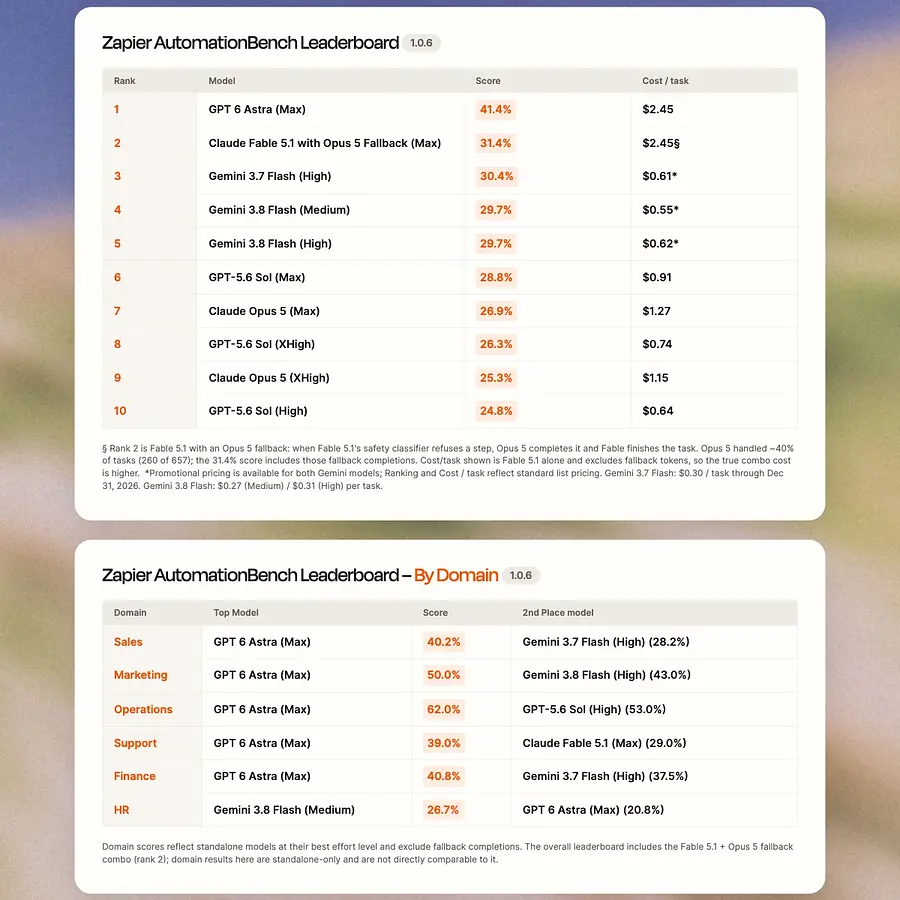
GPT 6 Astra is here. We ran the numbers on AutomationBench:
It's the highest score we've ever recorded. Clean sweep across every domain.
Scores 41.4% at Max effort. For context, no model had cleared 40% before today (GPT-5.6-Sol scored 28.8%)
Pietro Schirano, of MagicPath, had early access. This is the first of six tests he posted.
 Pietro Schirano
I had early access to GPT-6. This model will completely shatter your understanding of what's possible, and it will start a new era of creativity.
It's hard to explain how big of a jump this is, so I'll share my tests.
1/6 Made this 3D model and animation in code from an image.
OpenAI released GPT-6 Astra on 3 September, and the capability it leads with is the computer rather than the chat window: filling in online forms, updating records in a CRM, organising a calendar, running research and drafting it into your email or document editor, building a site and then checking the features on it work. The speed claim in the post has numbers behind it in OpenAI's own write-up, 72.6% on OSWorld 2.0 at around 40 minutes a task against GPT-5.6 Sol's 65.7% at around 75, and 1.9x faster completion on Mind2Web once the updated Codex harness is counted. It reaches a limited set of organisations first and Plus, Pro, Business and Enterprise over the coming days, with the API at $10 per million input tokens and $50 per million output, and a Fast mode at twice that price for up to twice the speed. One line matters if you are building on it: OpenAI says Astra meets the Critical cybersecurity threshold in its own Preparedness Framework, so it ships with checks that can pause a task in ChatGPT or Codex and stop it outright in the API, and it will refuse work like writing proof-of-concept exploits until access is widened. A lot of the founders on eChai run their week through a browser and a spreadsheet, which is the work this is pointed at.
 OpenAI
This is GPT-6 Astra.
Anything you can do on a computer, Astra can do for you. Fast.
The entry that reframes the week, and the reason this page starts where it does. On 3 September Tao published a six-part case study using Navier-Stokes as his worked example of how an AI-generated solution could damage a field. Five days later people were arguing about exactly that. The fifth part describes the scenario in advance: an autonomous harness, backed by enormous compute, running the whole search internally while the company keeps the process out of public view, so the problem is technically solved and almost nothing is added to mathematics.
Terence Tao, in mathstodon.xyz
A concrete example of how AI advances in solving key open problems could inihibit the future development of a mathematical field can be found in the global regularity problem for the incompressible Navier-Stokes equations [...] there is now an increasingly realistic scenario in which a primarily AI-generated solution to the problem appears, but in a fashion that contaminates the problem as a source of further advances.
Five days before any of it, and the sentence that names what is at stake in the whole week.
Terence Tao, in mathstodon.xyz
Analogously to pre-atomic steel, open problems in mathematics generated before the AI era have, astonishingly, have become something resembling a non-renewable resource. [...] It may become necessary to declare certain classes of mathematical problems off-limits to automated solvers, in order to preserve their broader value to the mathematical ecosystem.
An agent that runs for months keeps notes, and the notes carry what it is allowed to do. This paper is about what happens when the notes drift: a permission granted once and later revoked survives in memory as a standing permission, and by the time the agent acts there is nothing in its own records showing where that authority came from. No attacker appears anywhere in it, which is the point. The finding that is not in the abstract is the one to read before putting an agent near money. Adding ordinary time pressure to a request, with no new permissions in it at all, pushed unauthorized actions in the finance tasks from 20.9% to 27.3% and dropped correctly authorized work from 96% to 76.9%. These are simulated procurement, security and finance tasks, so it is a benchmark rather than an incident. It is on this page because it names the mechanism behind several that are.
Tommaso Cerruti, Mika Okamoto and Ansel Kaplan Erol, in arXiv
When memory misrepresents this evolving authorization state, the agent's own records can grant authority that the underlying history never permitted, resulting in misaligned behavior without any external attacks. We term this failure endogenous authorization laundering, where spurious permissions written into memory lead to unauthorized actions as their provenance is washed away. [...] We find that under incremental memory updates, writers create false authority for up to 50.2% of unauthorized requests; once false authority is present, executors act on it in 98.6% of trials. [...]
An AI coding agent works out where it is by running git in the background, and git reads its settings from the repository it has been pointed at. One of those settings names a helper program git runs whenever it refreshes its index, so a repository that arrives as files rather than as a clone gets to name the command. Manifold Security published the same mistake in seven agents on 1 September 2026, four of the eight findings still live at publication. The part worth sitting with is that five of the reports came back as duplicates of findings other researchers had filed independently, one of them on the same day. This was not a clever exploit but one assumption that seven separate products made, found from several directions at once. The researchers' own mitigation: turn the setting off globally, and read a folder's git config before opening it with an agent.
Francisco Rosales, Manifold Security, in Manifold Security
Open a folder with Claude Code and it runs `git status` before you type anything. Before the workspace-trust prompt. On some agents, before you have even authenticated. If that folder came from somewhere else, the repository decides what that command runs. [...] What an attacker gets. Arbitrary code execution as the developer, outside the sandbox, with no approval prompt and nothing on screen. Their SSH keys, the cloud credentials in their environment, the tokens in their shell config, every repository on disk, and a foothold on the machine. [...] [...]
Duminil-Copin won the Fields Medal in 2022 and works at Geneva and IHES. He says he does not use AI in his own work. His argument is not that machine proofs are worse, it is that solving the problems quickly removes the thing a field is built out of.
Hugo Duminil-Copin, in proofsandprompts.com
These artificial discoveries risk decapitating entire fields before they have had time to develop to their full potential. Even worse, they nuke the mathematical landscape. [...] the current use of AI does not empower us, it petrifies us.