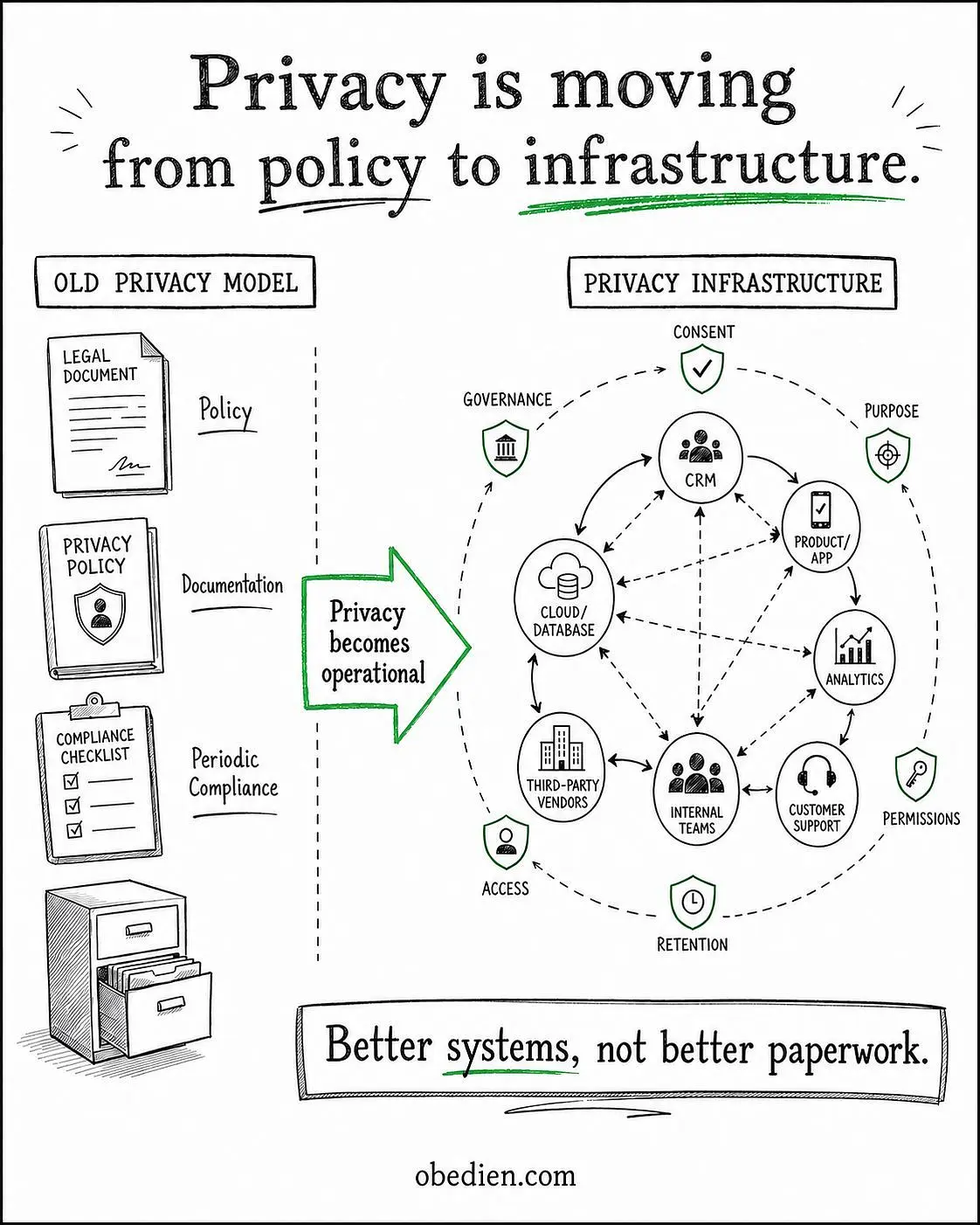
Privacy in India is moving from policy to infrastructure.
For years, businesses could treat privacy largely as documentation.
Write a policy. Maintain records. Review them periodically.
That is no longer enough.
Personal data now moves through CRMs, products, analytics tools, support systems, internal teams, and third-party vendors.
The harder questions are becoming operational:
What data do we hold? Why do we hold it? Where does it travel? Who can access it? And what actually happens across systems when someone withdraws consent or changes a preference?
That is the problem we are building Obedien to address.
Our thesis is simple:
"Privacy should become an operating layer of the business, not another compliance dashboard."
We are designing Obedien across two levels.
▫️For smaller businesses, privacy infrastructure should be accessible without enterprise complexity.
▫️For larger organisations, it needs deeper integrations, connectors, controls, workflows, and governance.
The principles remain the same. The infrastructure adapts to the complexity of the organisation.
I will focus on the regulatory architecture, business thesis, product thinking, and translating privacy requirements into real workflows.
My co-founder, Amish Trivedi, will lead the technology and engineering architecture.
My previous attempt at building a product taught me something I am carrying into this one:
You either succeed, or you learn.
The thinking behind Obedien became much sharper through conversations with Amish Trivedi and UV (Utpal Vaishnav). UV saw the opportunity early, challenged the thesis, and helped move it from an observation toward something buildable.
We know the difficult work is ahead.
We are not trying to build another compliance software company.
We want to help build the privacy infrastructure businesses will need for the next decade.
Starting from India.
The next era of privacy will be defined by systems, not paperwork.
That is where Obedien begins.