
Rushabh Shah

Rushabh Shah

Managing Partner · STIR Advisors

Profitable, in Vertical SaaS + AI/ML + Deeptech.

Building

Working on a lot of interesting tech projects, alongside the Investment Banking firm

On the Startup Grid
Walks on the Startup Grid
Hoping to meet
  • Enterprise / GCC buyer intros
  • Partners for my services or agency
  • Engineering leaders / CTOs
  • People obsessed with AI workflows
Asking for
  • I'd value an architecture or tech review from a senior engineer.. I'm looking for a technical advisor.. I'm looking for a CTO or first tech lead.
Writing
  • Rushabh Shah Rushabh Shah STIR Advisors 2w

    Apple spent a decade making privacy feel obvious.

    - App Tracking Transparency
    - Nutrition labels on the App Store
    - On-device processing
    - “Privacy. That’s iPhone.”

    It was not a policy PDF. It was product. Users started noticing. Ad tech had to rebuild. Privacy stopped being a footnote and became a market force.

    India’s DPDP story is the next chapter of that same shift with a different instrument.

    Apple used platform power. India used statute. Consent, purpose limitation, Data Principal rights, Significant Data Fiduciary duties, penalties that actually sting.

    The Rules are now live in phases, with the hard operating obligations marching toward May 2027. Companies do not get to treat this as a brand campaign. They have to treat it as how personal data moves through the firm.

    That is the parallel worth holding onto.

    Apple proved privacy can change behaviour when it sits inside the product. DPDP says privacy has to sit inside the operating system of the company - notices, consent, retention, deletion, vendor chains, audit trails. Dashboards that summarise the Act will not be enough. The work is in the daily practice of CAs, CSs and DPOs who have to make it real for the clients they advise.

    At Obedien, that is the lane we are building for: privacy as a working layer, not another slide in the compliance pack.

    Apple made users expect control.

    DPDP makes organisations prove they can deliver it.

    The open question for Indian firms is simple. Will privacy stay a policy note on the website or become part of how the business actually runs before the enforcement clock stops being abstract?
    Originally on LinkedIn →

  • Rushabh Shah Rushabh Shah STIR Advisors 5w

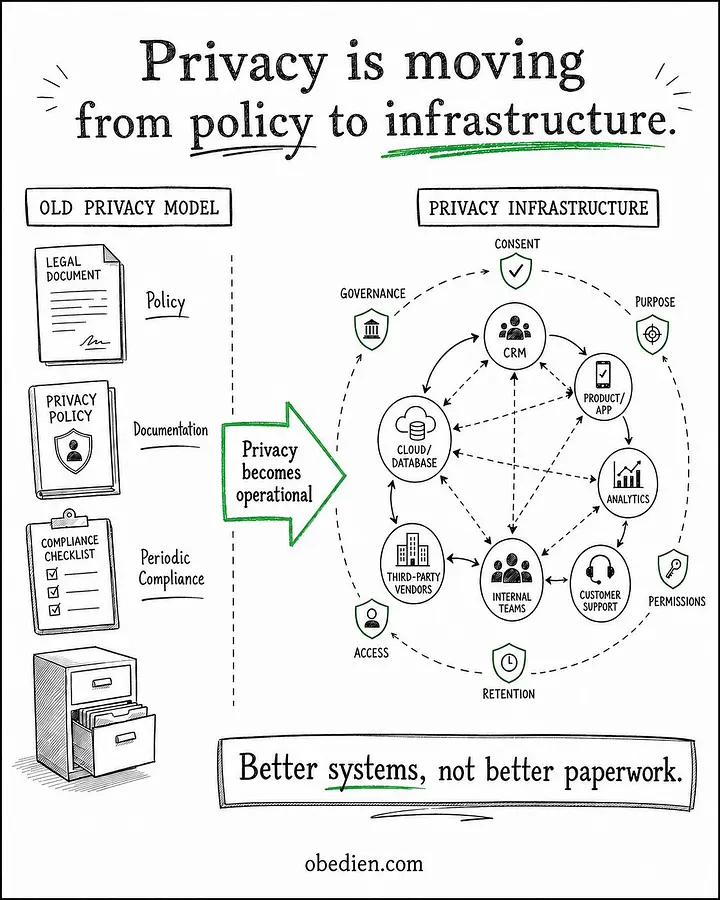
    Privacy in India is moving from policy to infrastructure.

    For years, businesses could treat privacy largely as documentation.

    Write a policy. Maintain records. Review them periodically.

    That is no longer enough.

    Personal data now moves through CRMs, products, analytics tools, support systems, internal teams, and third-party vendors.

    The harder questions are becoming operational:

    What data do we hold? Why do we hold it? Where does it travel? Who can access it? And what actually happens across systems when someone withdraws consent or changes a preference?

    That is the problem we are building Obedien to address.

    Our thesis is simple:
    "Privacy should become an operating layer of the business, not another compliance dashboard."

    We are designing Obedien across two levels.

    ▫️For smaller businesses, privacy infrastructure should be accessible without enterprise complexity.
    ▫️For larger organisations, it needs deeper integrations, connectors, controls, workflows, and governance.

    The principles remain the same. The infrastructure adapts to the complexity of the organisation.

    I will focus on the regulatory architecture, business thesis, product thinking, and translating privacy requirements into real workflows.

    My co-founder, Amish Trivedi, will lead the technology and engineering architecture.

    My previous attempt at building a product taught me something I am carrying into this one:
    You either succeed, or you learn.

    The thinking behind Obedien became much sharper through conversations with Amish Trivedi and UV (Utpal Vaishnav). UV saw the opportunity early, challenged the thesis, and helped move it from an observation toward something buildable.

    We know the difficult work is ahead.

    We are not trying to build another compliance software company.

    We want to help build the privacy infrastructure businesses will need for the next decade.

    Starting from India.

    The next era of privacy will be defined by systems, not paperwork.

    That is where Obedien begins.

    Originally on LinkedIn →

  • Rushabh Shah Rushabh Shah STIR Advisors 6w

    We are just getting started with the digital privacy guardrails that India needs. The DPDP act is taking shape and today is T0

  • Rushabh Shah Rushabh Shah STIR Advisors 6w

    What do founders discuss when the pitch decks are closed?

    Today, eChai Ventures brought together founders, investors and operators in Ahmedabad for a candid conversation with Hari Balasubramanian.

    It wasn't a rehearsed keynote when we met. The discussion moved from his early investment journeys involving Wow! Momo, Mukunda Foods Pvt. Ltd., Spinny, Rapido and Brevistay to some of the harder questions founders are confronting today:

    ▶️ Where is capital really going?
    ▶️ What has AI changed about building and selling software?
    ▶️ Is conventional SaaS becoming harder to fund?
    ▶️ How do founders and investors actually achieve liquidity?

    Recalling the conversations, I found a few ideas that stayed with me.

    ▫️Capital is no longer India's biggest constraint. The constraint is whether a team has a bold enough idea and the operating capacity to deploy that capital intelligently.
    ▫️AI has made building faster. It has not made distribution easier. Product creation is getting cheaper, while customer access, domain expertise, trust, and monetisation are getting more valuable.
    ▫️SaaS is not dead. But the comfortable middle is being squeezed. Either reach enormous user scale or own a workflow so deeply that a smaller number of customers will pay serious money.
    ▫️Paper valuation is not a return. Liquidity is. Many meaningful companies take 10 to 15 years to build, while the structures funding them often expect answers much earlier.

    Perhaps the most important lesson was this:

    A strong ecosystem is not built through speeches. It is built through rooms where people speak honestly, challenge each other and make the right introductions.

    Thank you, Hari Balasubramanian, for sharing decades of experience without trying to make the journey sound neat.

    Thank you, Jatin Chaudhary, Umesh Uttamchandani, eChai Ventures and DevX for creating the room.

    The carousel here distils the entire conversation.

    Originally on LinkedIn →

  • Rushabh Shah Rushabh Shah STIR Advisors 7w

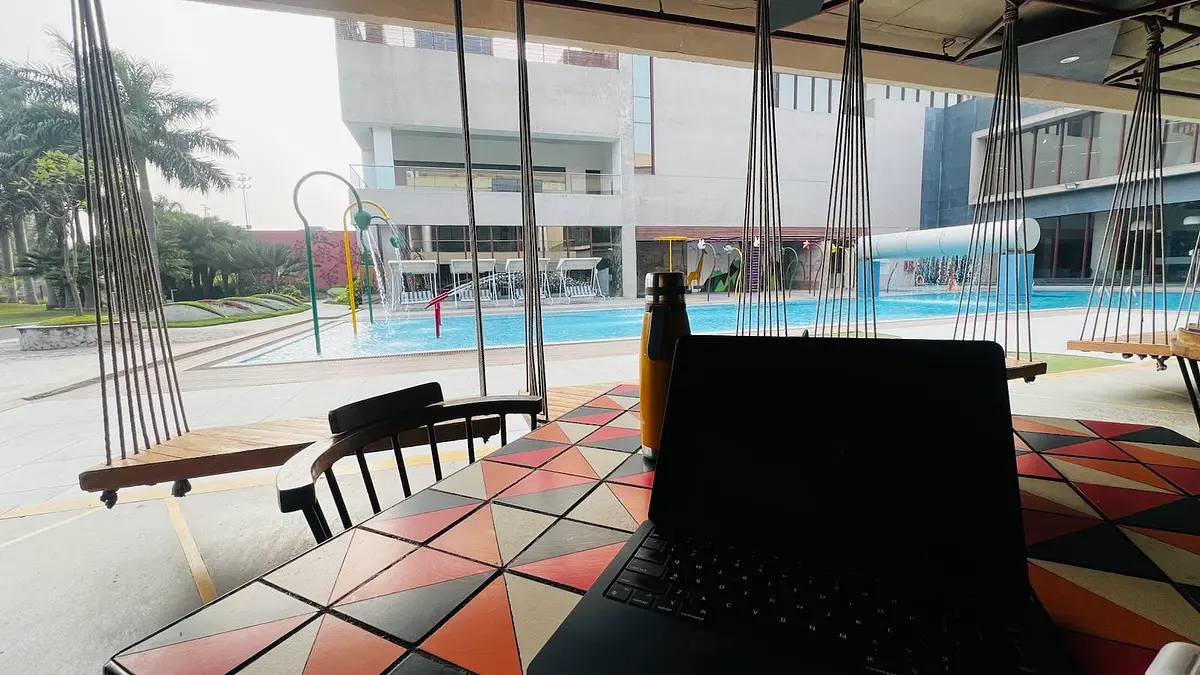
    My favourite space to work from, the third space, is the YMCA. I've been a regular visitor to the YMCA for a long time and have attended many meetings there.

    One of my core memories is that it was my go-to place when I was struggling to find the right niche. We had so many conversations and pitches with mentors and others around me. I think I spent a good six to eight months there, and it became a deep workspace for me when I was struggling.

    From Third Space →

The daily news quiz

Number one on 1 day.

More founders to meet The network →
Show more on the network →
eChai Partner Brands The partnership →