Jev is the future
Jack Cheng's post is three words and the film is the point: a canvas you draw on by pointing and speaking, with Jev turning the gesture and the words into the drawing action.
 Jack Cheng
23h
Jack Cheng
23h

A browser agent that finds flights in seven seconds. A Claude session cut from a million tokens to 86,000 in one second. A WHERE clause that reads plain English. Vercel's safety reviewer. We are collecting what people built with Jev in its first days, and what they argued about, each in their own words. Nobody in these bylines is on eChai, and every entry links back to where it was posted.
Jack Cheng's post is three words and the film is the point: a canvas you draw on by pointing and speaking, with Jev turning the gesture and the words into the drawing action.
Jack Cheng
23h
Jev is the future
Rob Hallam, on SuperX. A draft post gets 61 questions answered in about a second for $0.0004; the scorer is fitted on 9,481 real posts from 207 creators, picks the more viral of two posts two times in three, and is set up never to reward reply bait. Free to try at the link.
 Rob Hallam
1d
Rob Hallam
1d
Jev + SuperX = virality solved ✅
Every post gets 61 questions in ~1s for $0.0004 🤯
> fitted on 9,481 real posts from 207 creators
> picks the viral post 2 in 3 times
> never rewards reply bait
So: write, score, rewrite, stop when it peaks.
Free, no signup. try it below ↓
Mike Grabowski, of Callstack, on a proof of concept running agent-device (a mobile-device automation tool) with Jev, with the code and a short write-up in the replies.
 Mike Grabowski
1d
Mike Grabowski
1d
jevil is in the details 😈
built a quick POC running agent-device with jev and learned a ton.
check the source code or read a short blog post ⬇️
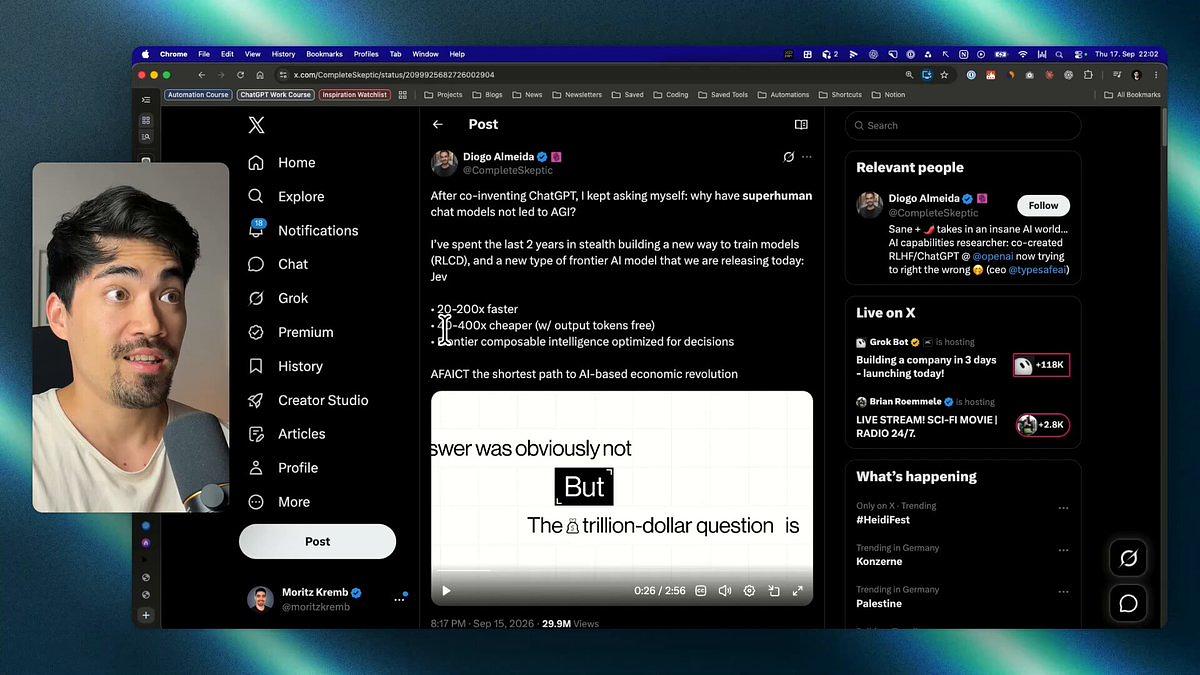
Moritz Kremb's 22-minute tutorial: what Jev is, the API, then three demos, a voice-controlled browser, an AI memory and a YouTube predictor. It plays where it was posted; the voice browser is open source.
 Moritz Kremb
1d
Moritz Kremb
1d
Full Jev Tutorial
What it is, how you can build with it and what new applications it can unlock
→ 0:00 Intro
→ 0:34 Jev explained
→ 4:06 API setup
→ 5:59 Demo 1: Voice-controlled browser
→ 11:33 Demo 2: AI memory
→ 17:27 Demo 3: YouTube predictor
Farouq Aldori's one-click invoice finder: Jev finds the billing page on any site, including Stripe portals, lists every invoice, and remembers where they live.
 Farouq Aldori
1d
Farouq Aldori
1d
Jev is fun! One-click invoice finder for any website 🧾
- Automatically finds billing pages using @typesafeai's Jev
- List/download all invoices with 1 click
- Works with Stripe billing portals too
- Remembers where invoices live for next time
Should I open-source it?
Ope Oginni's permissions plugin for opencode: instead of predicting every shell command an agent might run, the rule is written in plain language ('every domain except Google is blocked') and Jev judges each attempt by intent. He says it caught every route the agent tried.
 Ope Oginni
1d
Ope Oginni
1d
Built an intent-aware permissions plugin for @opencode
No need to predict every shell command an agent might use. I blocked access to every domain except Google by intent Jev caught every route the agent tried
Permissions written in natural language. Powered by @TypeSafeAI Jev!
Joey Kudish's second Jev package, a browser-use agent, open source at the link.
 Joey Kudish
1d
Joey Kudish
1d
Built browser use using @typesafeai's new jev model
It's really fast and very cheap and absolutely mogs a traditional LLM for most browser tasks.

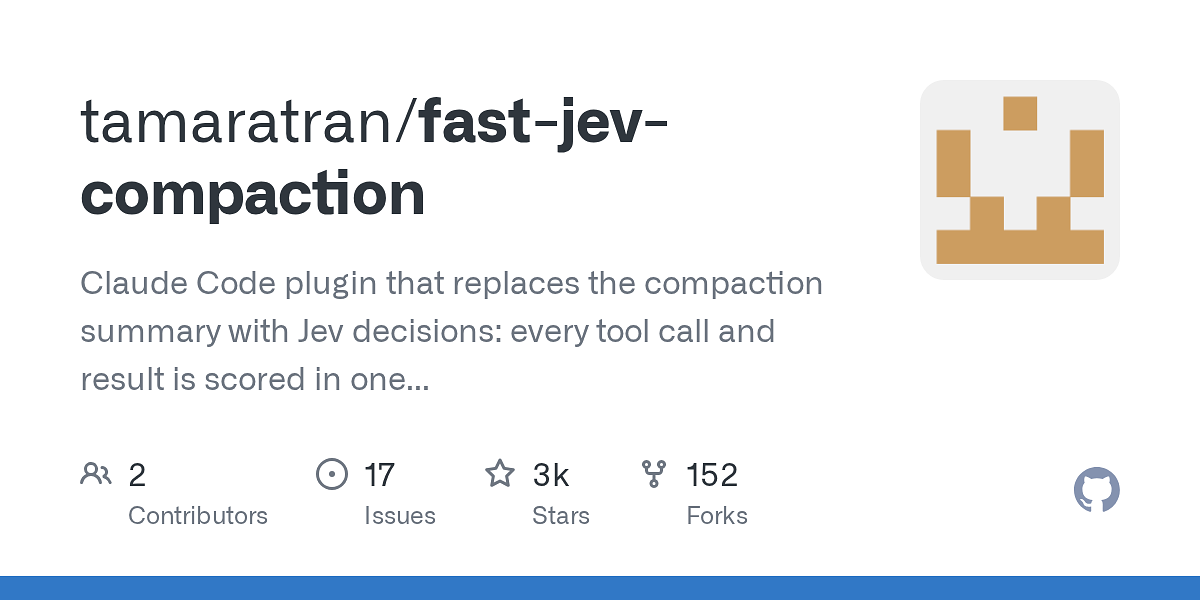
Tamara Tran's is the post the week's biggest idea came from. Every coding agent compacts a full context window by asking a model to summarise it; her plugin instead has Jev score every tool call in the transcript and drop the ones that no longer matter, in about a second. It is open source as fast-jev-compaction, and Diogo Almeida's reply was that it frees coding agents from designing around the KV cache.
 Tamara Tran
1d
Tamara Tran
1d
found the perfect use case for @typesafeai Jev:
instant compaction
in 2026, why is compaction still a summarization prompt?
Jev can make it instant by scoring every tool call and dropping what’s irrelevant
Zachi's jev() is the entry on this page that most changes what a piece of software can be: a PostgreSQL function that takes a row and a plain-English question and returns whether it holds, so a WHERE clause can read 'could work from home'. No index and no embeddings; 129 rows judged in about a second for $0.0009, and a cached second run in 6 ms.
 Zachi
1d
Zachi
1d
I think I just cooked something 🔥
jev(): a PostgreSQL extension that searches your whole database in natural language. No index, no embeddings, just one function.
WHERE jev(people, 'could work from home')
or
WHERE jev(people, 'name sounds european')
129 rows judged in ~1s for $0.0009. Second run: 6ms from cache.
Jarrod Watts again, with a 24/7 Twitch stream of Jev trying to beat Minecraft's Ender Dragon one decision at a time.
 Jarrod Watts
1d
Jarrod Watts
1d
Introducing Jev Plays Minecraft!
A 24/7 livestream where Jev attempts to defeat the Ender Dragon, one decision at a time.
→
Ian Nuttall gave Jev his whole X archive: 3,282 posts and eight questions each, 4.25 million tokens, $0.1282, eight and a half minutes. What came out is which topics, hooks and tones actually carried in his own numbers.
 Ian Nuttall
1d
Ian Nuttall
1d
I gave Jev 3,282 of my X posts across 100M views and asked it to find what actually works for growth.
4,252,330 tokens $0.1282 for the full 8m 34s run!
Each post got 8 questions about the topic, hook, tone, whether it teaches something, etc.
How-to posts got 150 median likes vs the average median of 44.
AI and coding was a 1.9x multiplier topic compared and SEO, despite recent posts, was right at base median 1.0x - surprisingly.
The recommended topic + angle + voice formula was:
AI coding + teach something + provocative
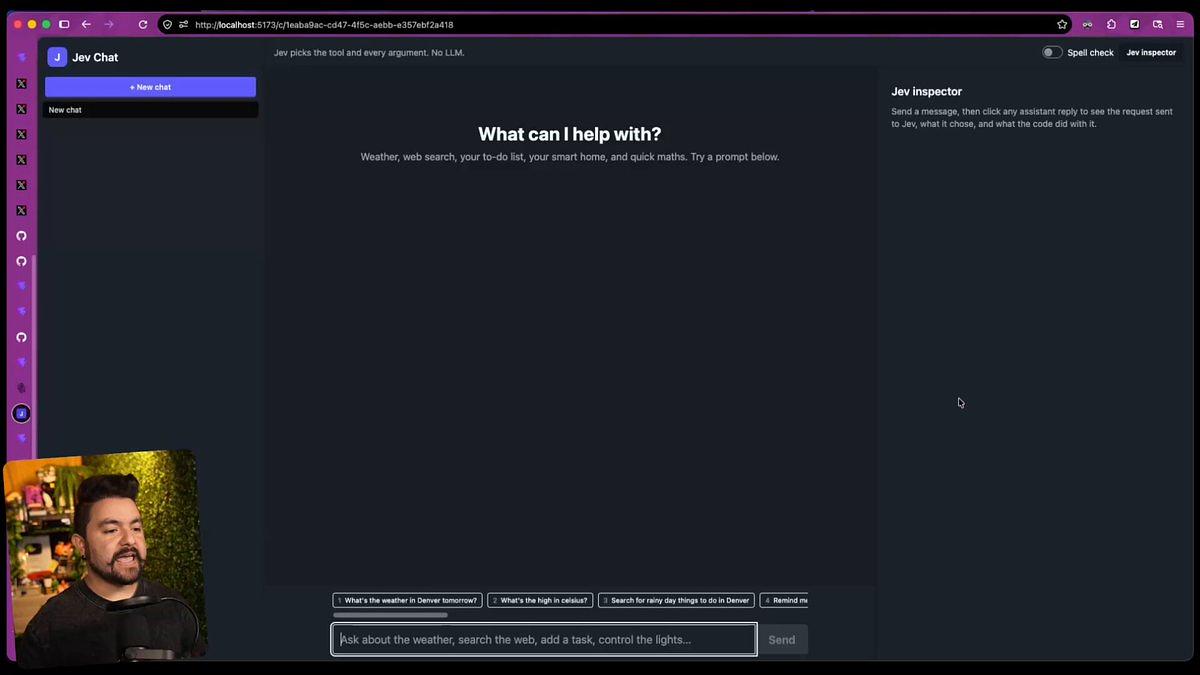
CJ, of Coding Garden, built a chat bot with no language model in it at all. Jev picks the tool (web search, Wikipedia, weather, Todoist, Home Assistant) and its arguments from the prompt, the tool answers, and the answer cites its source. The film runs over four minutes, so it plays where it was posted.
 CJ (Coding Garden)
1d
CJ (Coding Garden)
1d
I built a chat bot with jev, no LLM at all! Responses are instant, no hallucinations.
I hooked it up to web search, wikipedia, weather, todoist and home assistant.
Jev decides what tool to call and what args to use based on the prompt. Instant answers cite sources as well!
David Fant, on how an agent gets ten times faster and cheaper with Jev in it: routing, computer use, action review, and subagent orchestration, each pointing at somebody's demo.
 David Fant
1d
David Fant
1d
jev will make agents 10x faster and cheaper, here's how:
1/ model routing: pick the right model for each task, without training a custom router
https://x.com/mdlahfir/status/2100314182201802811?s=20
2/ computer use: faster, cheaper and more reliable for action-heavy tasks
https://x.com/gregpr07/status/2100411066966749359
3/ auto review: ask jev whether an action is safe, instead of using a slow and expensive LLM
https://x.com/fazxes/status/2100300097695232164?s=20
4/ less obvious: subagent orchestration
long-running agents (cursor projects, grokbot, energy) parallelize work with subagents.
but every user message, email, or subagent reply can wake the expensive orchestrator.
example: it costs $1 to wake up gpt 6 astra w 100k input tokens
jev can decide what each event needs:
- route directly to a subagent
- queue for later
- wake the orchestrator
Matthew Berman, who says this is coming to Steal Ads and as an MCP: 724 live ads from 37 brands, each broken down by hook, format, offer, call to action, awareness stage and whether the landing page matches, in 40 seconds for nine cents of tokens.
 Matthew Berman
1d
Matthew Berman
1d
jev is INSANE.
in 40 seconds it broke down 724 live ads from 37 brands.
every hook. every format. offer. cta. awareness stage. landing page mismatch. used 9 cents of tokens.
(will be avail in @stealads + mcp)
Cua builds the open-source computer-use agent of the same name. jev-use is Cua's driver with Jev deciding each step, in development preview on macOS, Windows and Linux; the pull request is at the link.
 Cua
1d
Cua
1d
1/ Fast Computer Use is now solved with @typesafeai Jev + Cua Driver.
Available in development preview for macOS, Windows, and Linux. We call it jev-use.
Draft #3943: