DiffusionGemma-as-Jev (aka djev) running near-real-time vision detection from a mobile phone using its native vision tower.
Please don't fall down the stairs!

A browser agent that finds flights in seven seconds. A Claude session cut from a million tokens to 86,000 in one second. A WHERE clause that reads plain English. Vercel's safety reviewer. We are collecting what people built with Jev in its first days, and what they argued about, each in their own words. Nobody in these bylines is on eChai, and every entry links back to where it was posted.
5 entries Clear
Matt Mastracci's djev: DiffusionGemma made to answer like Jev, running near-real-time vision detection on a phone through the model's own vision tower.
 Matt Mastracci
4h
Matt Mastracci
4h
DiffusionGemma-as-Jev (aka djev) running near-real-time vision detection from a mobile phone using its native vision tower.
Please don't fall down the stairs!
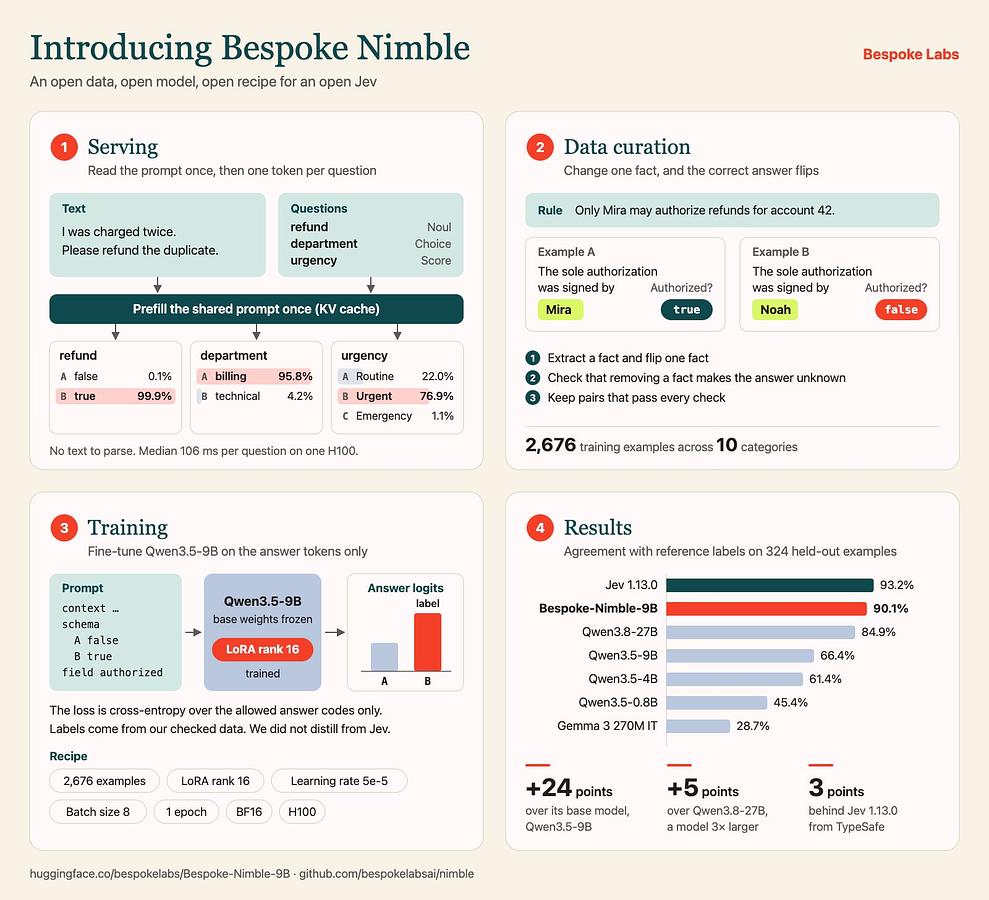
Mahesh Sathiamoorthy runs Bespoke Labs. Nimble is an open Jev: open data (fully synthetic, curated by slightly altering facts to make negatives), an open recipe (a LoRA fine-tune of Qwen 3.5 9B, Jev used only to evaluate, no RL yet), an open model on Hugging Face, and parallel constrained decoding to serve it. He states the caveat himself: there is no standard benchmark, so Nimble may be much worse than Jev elsewhere.
 Mahesh Sathiamoorthy
5h
Mahesh Sathiamoorthy
5h
Introducing Bespoke Nimble: an open data, open model, open recipe for an open Jev.
Code and info: https://github.com/bespokelabsai/nimble
Model: https://huggingface.co/bespokelabs/Bespoke-Nimble-9B
Data:
* A new data curation recipe called contrastive data curation.
* Slightly change facts to generate negative data. This pushes the model to discriminate better and become a better decision maker. The calibration is implicit.
* Didn't do ablations but I think this is a critical piece!
* This also means training data doesn't need probabilities.
* Data covered 10 categories, and is fully synthetic.
* This data is split into train and eval.
Training
* LoRA finetune of Qwen3.5-9B.
* Distillation-free: we use Jev to only evaluate.
* No RL yet!
Serving
* Parallel constrained decoding as suggested by @NielsRogge and @harshagundal.
Results:
* The post-trained Qwen (Nimble) became substantially better on our curated eval: 66% for Qwen to 90% for Nimble. Jev is at 93%.
* 100ms on H100 and free to use on your macbook! Feel the AGI for free.
* 2 days of building in public. :)
Big caveat is that there is no standard benchmark to measure performance, and it's possible Nimble is much worse on other benchmarks compared to Jev. But it should be better than Qwen!
We thank @typesafeai for making Jev and the inspiring discussions in the community. Hope this release lifts all the boats and encourages more research and activity in this space.
Kshetrajna Raghavan works at Shopify. Reflex is a Qwen 3.5 model doing structured decisions with probabilities entirely in the browser on WebGPU, which Tobi Lütke passed on with the line 'Here, have jev running in your browser'.
 Kshetrajna Raghavan
22h
Kshetrajna Raghavan
22h
“Wonder if we could build that?” is a pretty normal response to new tech at @Shopify. Its a fun place to work 😄
Jev got me curious, so I built Reflex: a Qwen-based experiment in structured decisions + probabilities running on WebGPU
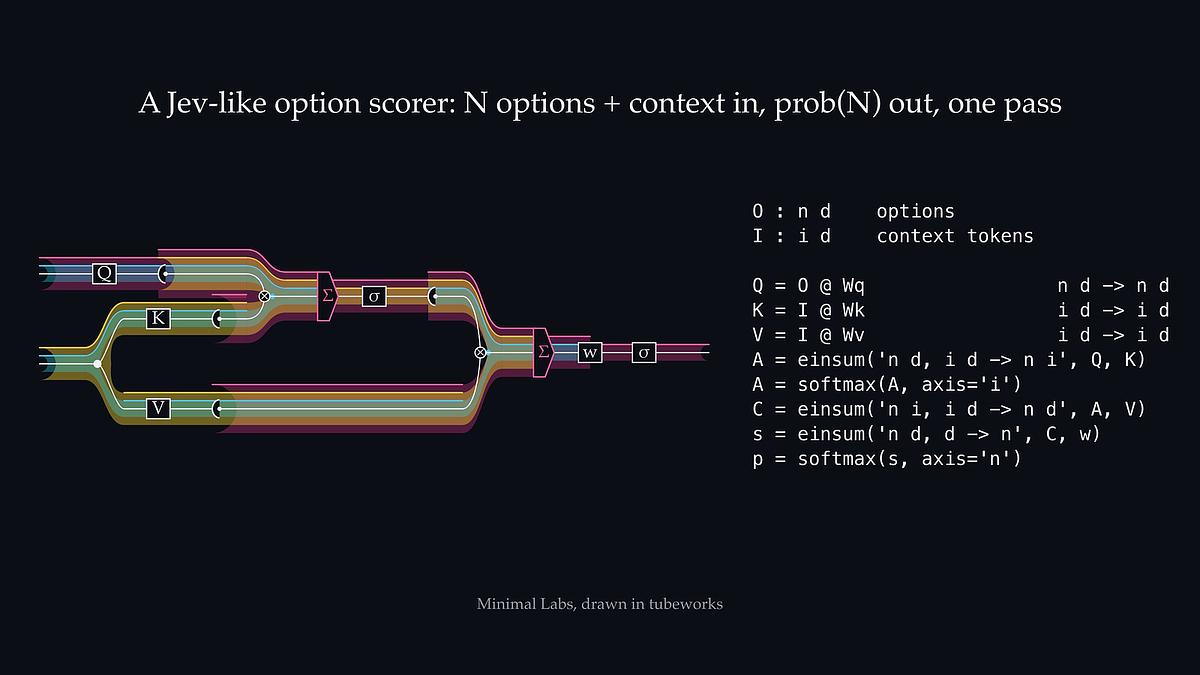
Vincent Wang-Maścianica reverse-engineered a Jev-like architecture from the interface alone and published the training code, so anyone can train their own.
 Vincent Wang-Maścianica
2d
Vincent Wang-Maścianica
2d
I reverse-engineered a jev-like architecture given its type. You can find the repo here to train your own jevlikes:
Harsha Gundala's answer to the two years in stealth, posted the morning after: a Qwen 2.5 1B set up to batch every key of a JSON schema in one pass and hand back probabilities over the categories, running on an M4 MacBook, on Hugging Face. His point is that any LLM can be made to do this without new training.
 Harsha Gundala
2d
Harsha Gundala
2d
They were building in stealth for 2 years, I was building in stealth for 2 hours…
Happy to open source Qwen-2.5-1B-RLCD, 5x faster on-device inference for JSON workloads that need to be type-safe.
⚡️Demo below on a M4 MacBook⚡️
every LLM has the ability to efficiently batch inference every key of a JSON at the same time and generate probabilities from a set of possible categories. No new training required, but it’s easy to optimize if you need!
On hugging face now!