Ok, jev is really cool. So many great use cases where a fast and accurate yes/no gate can deliver meaningful performance gains.
Played around and built some showcase examples here →

A browser agent that finds flights in seven seconds. A Claude session cut from a million tokens to 86,000 in one second. A WHERE clause that reads plain English. Vercel's safety reviewer. We are collecting what people built with Jev in its first days, and what they argued about, each in their own words. Nobody in these bylines is on eChai, and every entry links back to where it was posted.
7 entries Clear
Andre Landgraf's showcase of the yes/no gate, several worked examples at the link.
 Andre Landgraf
1h
Andre Landgraf
1h
Ok, jev is really cool. So many great use cases where a fast and accurate yes/no gate can deliver meaningful performance gains.
Played around and built some showcase examples here →


Ope Oginni's permissions plugin for opencode: instead of predicting every shell command an agent might run, the rule is written in plain language ('every domain except Google is blocked') and Jev judges each attempt by intent. He says it caught every route the agent tried.
 Ope Oginni
1d
Ope Oginni
1d
Built an intent-aware permissions plugin for @opencode
No need to predict every shell command an agent might use. I blocked access to every domain except Google by intent Jev caught every route the agent tried
Permissions written in natural language. Powered by @TypeSafeAI Jev!
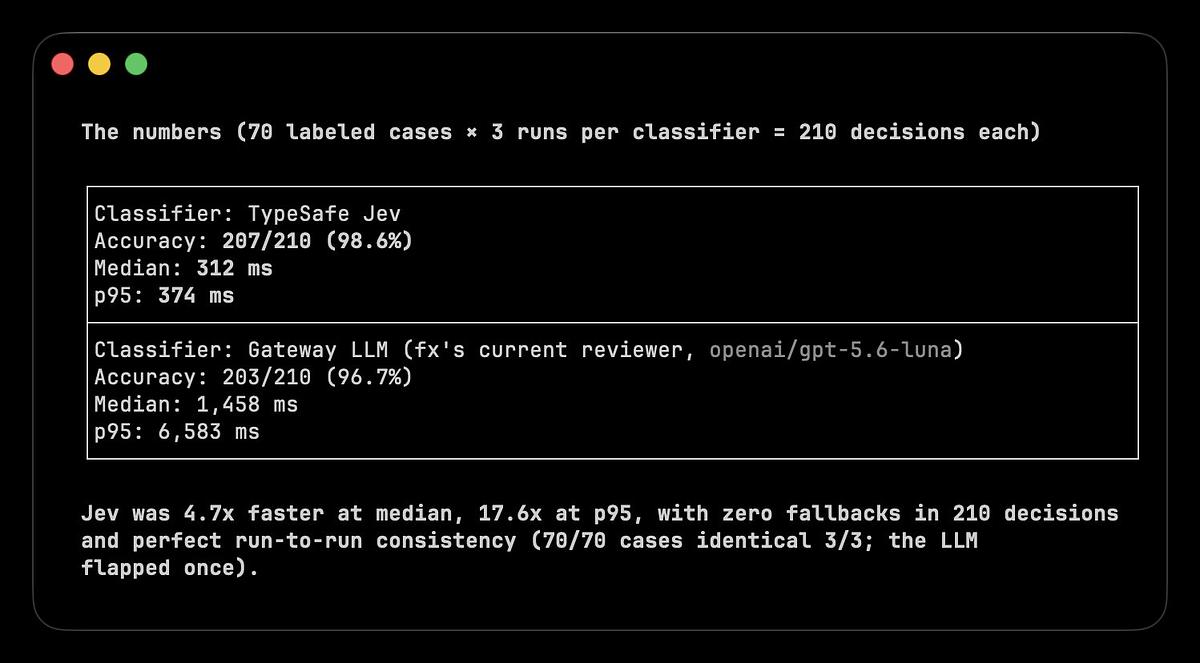
Guillermo Rauch is the CEO of Vercel. fx is Vercel's coding agent, its default mode is auto, and every command it runs is checked first by a safety reviewer. That reviewer runs on GPT Luna; the Vercel team benchmarked Jev in its place and found it up to 18x faster at p95 and more accurate, which Rauch says makes it the likely new default. The first production guardrail anyone named this week.
 Guillermo Rauch
2d
Guillermo Rauch
2d
We're seeing extraordinary results from @typesafeai. Default mode in 𝚏𝚡 is auto, with a safety reviewer analyzing every command.
That reviewer runs on GPT Luna today. Jev is up to 18x faster (p95) *and* more accurate. It's coming to @vercel AI Gateway and likely new default.
Pranit, on the Vercel team, with the benchmark behind Guillermo Rauch's post: the fx auto-mode safety classifier on Jev against gpt-5.6-luna, five to eighteen times faster and more accurate.
 Pranit
2d
Pranit
2d
We benchmarked fx auto mode (safety) classifier with @typesafeai's Jev.
tl;dr: ~5-18x faster and more accurate than 𝚐𝚙𝚝-𝟻.𝟼-𝚕𝚞𝚗𝚊, our current top choice
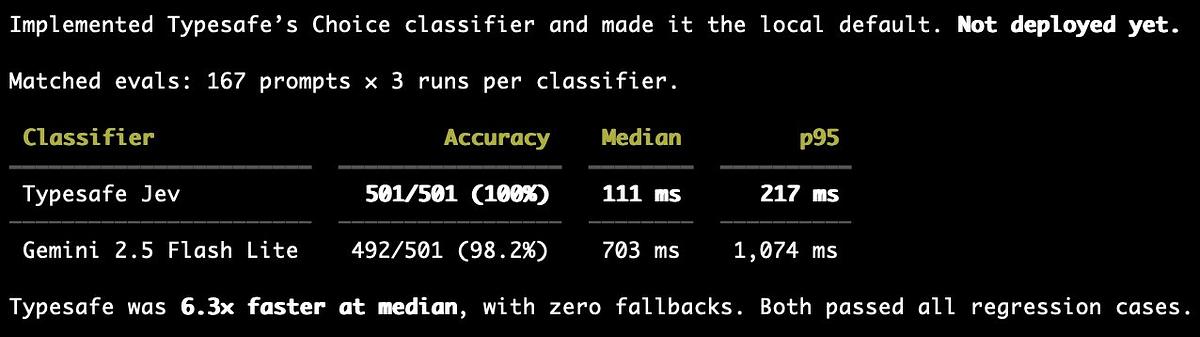
Malte Ubl is Vercel's CTO. An existing classifier eval that had been running on Gemini 2.5 Flash Lite: Jev saturated it and answered six times faster.
 Malte Ubl
2d
Malte Ubl
2d
Ran @typesafeai's Jev against an existing classifier eval that previously used Gemini 2.5 Flash Lite. It won both on quality (saturated the eval) and speed (6x)
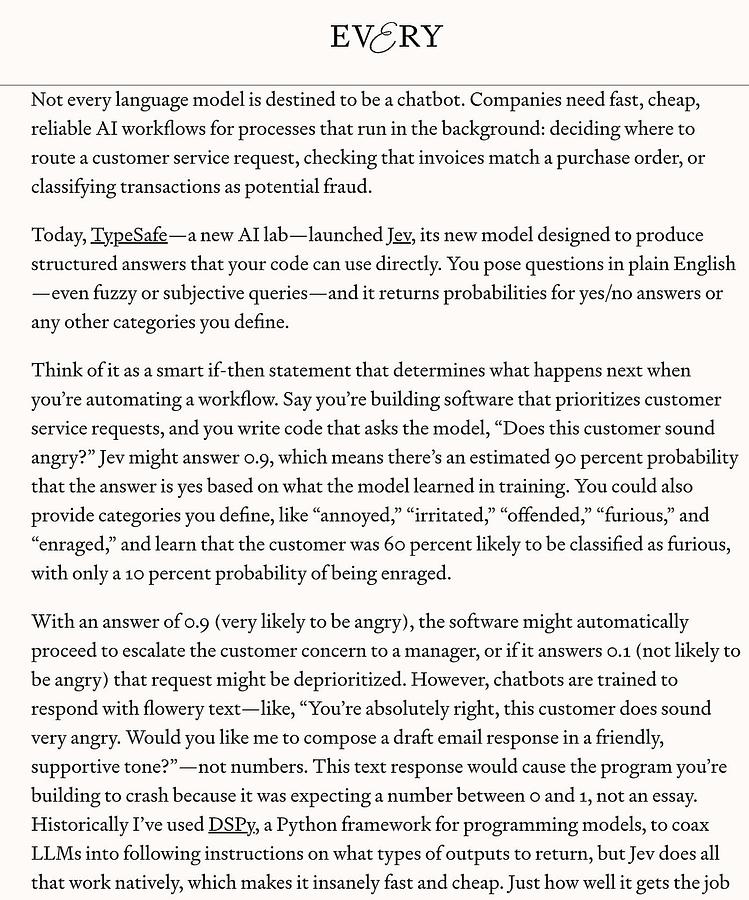
Dan Shipper is the CEO of Every. Mike Taylor, its head of evals, fed Jev 37 documents with 21 questions each and got 777 judgments back in 0.7 seconds for about a quarter of a cent. Every's second test is the one independent number so far: on 12 passages with planted writing defects Jev caught six of seven where Fable 5.1 caught all seven, at 0.35 seconds a passage against 8.83, which is 25 times faster rather than the 200 in the launch claim.
 Dan Shipper
3d
Dan Shipper
3d
we almost never test new foundation models but we've been testing this for ~a week @every and it's pretty wild.
the kind of things that will be obviously indispensible in 6-12 months
it doesn't produce words as output, it produces probabilities. so it can efficiently act as a judge in cases where you'd need a Fable-level model—but in our testing was 25x faster and 600x lower priced
excellent vibe check by @hammer_mt on @every:

Alex Duffy runs Goodstart Labs, which builds learning environments for agents and needs every action graded. On their sample Jev agreed with Fable 5.1 nine times in ten, at about 200 times lower grading cost and under half a second a call. Erik Gafni, named in the post, is one of TypeSafe's three co-founders.
 Alex Duffy
3d
Alex Duffy
3d
Awesome to see @EGafni & Diogo launch their first model Jev!
Verification is the bottleneck for building great AI learning environments. Jev is a welcome, unique, addition to our toolkit @goodstartlabs
Typed decisions,
probabilities for each option,
free output tokens!
On our sample:
• Jev agreed with Fable 5.1 nine times out of ten
• ~200× lower grading cost
• <0.5 seconds per grading call
That means more eyes on what agents are doing and what we’re teaching them.
More on how we’re using it to build game environments, experts to play them, and ensuring they teach the right things: