Starting Up
The resources founders actually use.
Every essay, video, podcast, book and tool behind 1,327 answered founder questions, in one place, each with a note on why it is here.
What founders use most, ranked by how many answers lean on it.
- Built around picking one Highlight per day and defending it, which maps cleanly onto shipping one small thing in every build... Jake Knapp and John Zeratsky Book · Book, ~300 pages Make Time: How to Focus on What Matters Every Day Jake Knapp and John Zeratsky
- A collection of what founders and operators actually do to protect time, including treating the calendar as a strategy document... Lenny's Newsletter Article · Long-form newsletter post Time management techniques that actually work Lenny Rachitsky
- The Make Time authors walk through how they actually defend a daily Highlight and fight the pull of reactive work, in... Lenny's Podcast Podcast · ~1 hour episode Making time for what matters (Jake Knapp and John Zeratsky) Lenny Rachitsky
- Barry built his career on a daily writing streak, and his story is the clearest argument for shipping one small thing every day... Nathan Barry Essay · ~1,200 words The commitment that changed my career Nathan Barry
- Solo weekly shipping is a long game, and this short essay makes the case that endurance, showing up week after week, is what... Nathan Barry Essay · ~1,000 words Endure long enough to get noticed Nathan Barry
- A daily planner built specifically for timeboxing, so you drag tasks (including your fixed support and sales windows) onto the... Sunsama Tool · Daily planning app Sunsama Sunsama
-
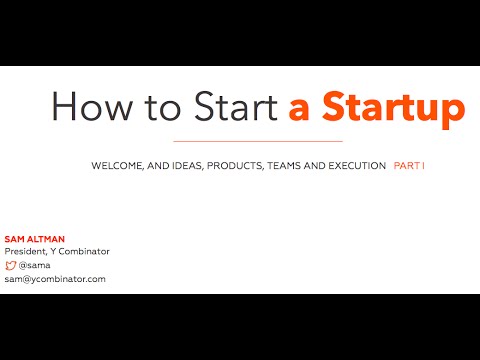 Video · About 50 min
How to Start a Startup, Lecture 1: Ideas, Products, Teams and Execution
Sam Altman and Dustin Moskovitz
- The consumer companion to the B2B piece, covering how Airbnb, Twitter, Pinterest, Tinder and others began. Many ideas felt... Lenny's Newsletter Article · About 15 min read How the Most Successful Consumer Startups Came Up With Their Idea Lenny Rachitsky
- Isenberg is practical about finding underserved, unsexy niches where people are literally asking for tools that do not exist... Greg Isenberg (gregisenberg.com) Article · ~12 min read Find winning startup ideas from AI and data Greg Isenberg
- The founders of 37signals (Basecamp) explain how they built tools for their own problems without focus groups or market... REWORK by 37signals Podcast · 25 min Scratch Your Own Itch Jason Fried and David Heinemeier Hansson
- A useful counterweight if you are frozen trying to find the single perfect idea. Gil argues the market you pick matters more... blog.eladgil.com Essay · ~6 min read You Don't Need A Good Idea To Start A Great Company Elad Gil
- A tight, investor's checklist for the exact decision you are making. Bent leads with choosing a burning idea you cannot stop... Mercedes Bent, Lightspeed (Medium) Article · ~12 min read How to Choose a Startup Idea Mercedes Bent
- This speaks straight to the kill the lukewarm ones part of the answer. Hedging across several ideas feels safe but actually... Startups.com Article · ~8 min read The Problem With Working on Multiple Ideas at Once Wil Schroter
- A ready made place to write each idea as a one line problem and score it on the criteria that matter to you. Putting all your... Notion Marketplace Template · Template Idea Rating Scorecard (Notion template) Notion Marketplace
- An Indian founder podcast episode about the messy stage before you commit, which Aditya Agarwal calls minus one. It treats... The Neon Show Podcast · ~60 min Where Founders Take Figuring Out as Seriously as Building (South Park Commons) Siddhartha Ahluwalia
-
 Video · ~20 min
Kunal Shah on the Delta 4 Theory (TechSparks talk)
Kunal Shah
- A focused conversation on how consumer motivation and trust differ between India and the West, and what that means for which... Return on India podcast Podcast · ~1 hr Kunal Shah: Exploring Consumer Psychology (Return on India) Return on India and Kunal Shah
-
 Video · ~1 hr
Paras Chopra in conversation with Kunal Shah (CRED curious)
Paras Chopra and Kunal Shah
- A field study of startups serving low and middle income Indian customers, focused squarely on the price sensitive buyer. It... IIMA Ventures Insights Article · ~12 min read Bharat Startups: The Price Sensitive Customer IIMA Ventures
- Blank invented the get out of the building idea, and here he makes the sharpest version of the case: until you test your... steveblank.com Article · ~8 min read No Plan Survives First Contact With Customers Steve Blank
- Bezos separates decisions into one way doors you cannot undo and two way doors you can walk back through. Deciding to build a... Amazon shareholder letter (Jeff Bezos) Essay · ~6 min read (relevant section) 2015 Letter to Shareholders (Two-Way Doors) Jeff Bezos
- A conversational walkthrough of how to move from a hunch to a tested idea quickly, good for a commute when you do not want to... Lenny's Podcast Podcast · podcast episode Rapidly Test and Validate Any Startup Idea Lenny Rachitsky
- This is the most concrete method we found for collecting the complaints nobody has fixed when you cannot yet get people on... Solving Product (Amy Hoy and Alex Hillman method) Article · Medium read How to Find New Product Opportunities with a Sales Safari Étienne Garbugli
- Bob Moesta, one of the originators of Jobs to be Done, shows how to interview people about the struggling moment that made them... Business of Software (Bob Moesta) Video · About 45 min Demand-Side Sales 101 (talk) Bob Moesta
Playbooks
A goal, and the route through it a step at a time.
Find an idea worth pursuing
Spot problems worth solving and find the one that actually fits you.
Validate before you build
Get real evidence people want it before you write a line of code.
Understand your customers
Talk to real users, define who you're for, and read the market clearly.
From idea to first customers
The idea-stage spine: find a problem, prove it, talk to customers, and land the first ten.
Build an MVP without code
Ship a first version with no-code tools before you hire anyone.
Build and launch your first product
Turn a validated idea into something real people can use.
Find and work with developers
Hire, brief, and work with builders without getting burned.
Name and brand your startup
Name it, design an identity, and say what it does in a line.
Build a landing page that converts
A page that loads fast, earns trust, and turns visitors into signups.
Get your first customers
The scrappy, unscalable work of going from zero to your first paying users.
Sell it yourself, founder-led
Reach out, run the conversation, and close before you have a sales team.
Grow with content and SEO
Compound reach with content, search, and a founder audience.
Grow with paid ads
Spend that returns: the channels, metrics, and loops behind it.
Price and package your product
Charge for value, package it right, and check the numbers work.
Bootstrap instead of raising
Fund growth from revenue, and keep control of your company.
Raise your first round
Understand the game before you pitch: whether to raise, from whom, and on what terms.
Find a co-founder, split equity
Find the right partner and split equity without regret.
Set up the company right
Incorporate, split equity, protect your IP, and make your first hires.
Survive founder life
Mindset, burnout, the leap, and the parts nobody warns you about.
Build in India
The India-specific playbook: schemes, government, enterprise, and the local market.
The questions founders start with
What are good startup ideas in India right now?
The ideas Indian investors are backing in 2026 sit in a few places: AI built into one industry's daily work (vertical AI for B2B, where software fu...
How do I find product-market fit?
Narrow until a small group cannot do without you, then widen. Pick the segment where usage is strongest, talk to those people every week, and chang...
Do I actually need a co-founder, or can I go solo?
You don't strictly need one, but the data says teams outlast solos: complementary skills, shared load, and someone to argue you out of bad calls al...
How do I build an MVP for my startup, step by step?
Write down the one assumption that kills the idea if it is wrong, then build the cheapest thing that tests it and get it to real users within weeks...
Which tool should I use to analyse qualitative data like interview notes?
For a founder with a dozen interviews, Gemini Notebook, which is free, or Claude, free or $20 a month on Pro: load the transcripts, ask for the rec...
How do I get my first client as a freelancer?
Your first client is most likely someone who already knows you or someone they know, so start there before marketplaces. 1) Pick one service for on...
How do I decide how much to charge for my product?
Stop guessing and stop pricing off your costs, price off the value the customer gets and their willingness to pay. Talk to customers about pricing,...
Should I raise venture capital or bootstrap my startup?
Raise VC only if your business needs a big pile of cash to reach escape velocity before someone else does, and if a 10x-in-a-few-years outcome is g...
Questions for your situation
eChai Partner Brands
The partnership →